

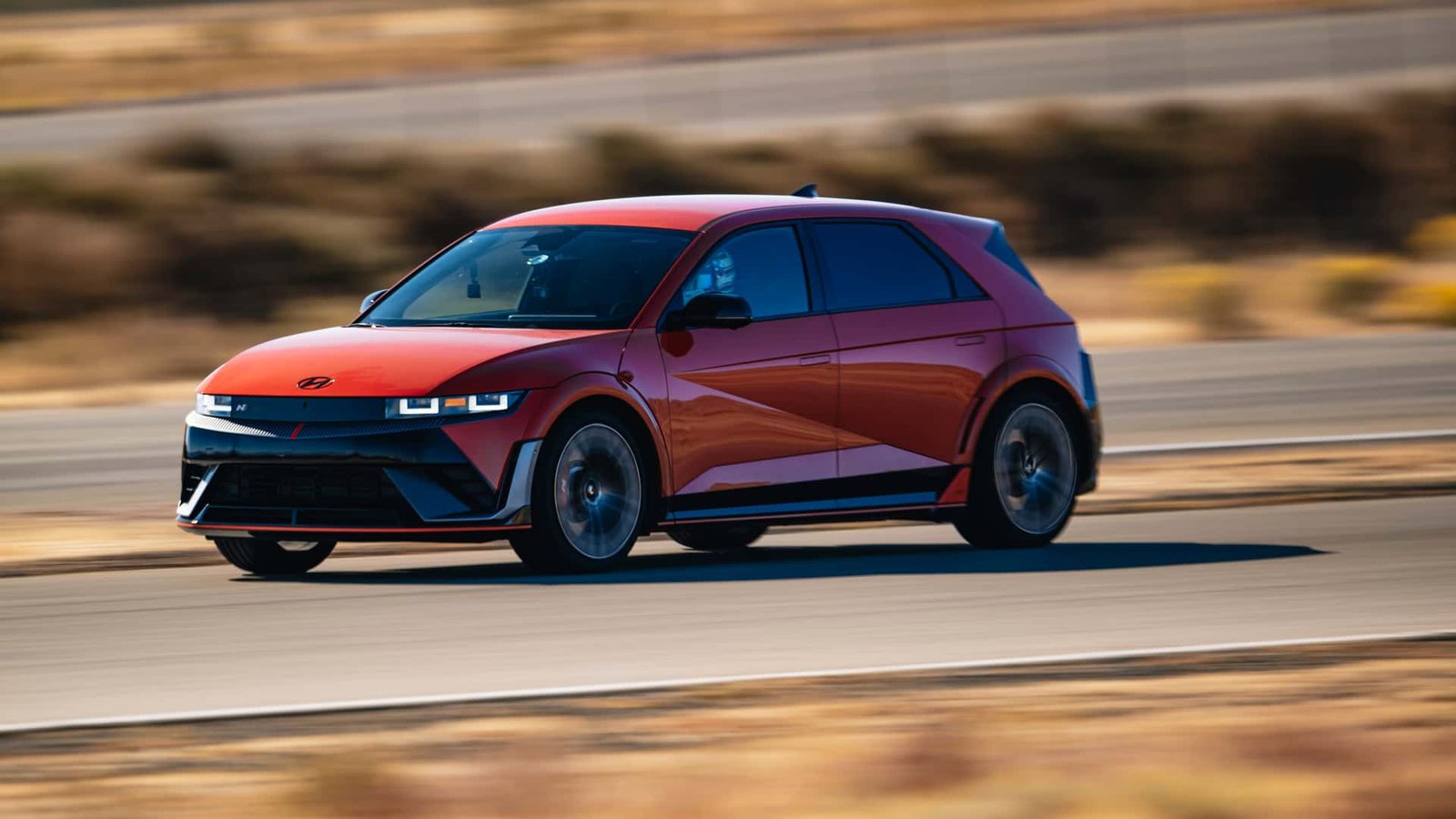
- A recent Stanford study shows that EV batteries benefit from “dynamic” driving.
- This means that the occasional spirited driving could actually help keep your battery feeling young.
- Dynamically-cycled batteries can last 38% longer than those babied only at highway speeds, or the equivalent of 195,000 miles.
Back in the day of carburetors and leaded gas, sparsely driven cars often found themselves running a bit rough. The mechanic’s remedy? The good ol’ Italian tune-up—revving high to clear out carbon deposits and other gunk from the engine.
It turns out that the same methodology is actually good for EVs as well. Strange, I know, especially since EVs don’t exactly burn fuel. But as a study published by Stanford shows, “dynamic-cycling” (as it’s called) a battery improves a cell’s lifespan by as much as 38%.

Photo by: CATL
Dynamic Cycling Is Key
Basically, the researchers’ goal was to figure out what kind of driving habits were better for cell longevity. Was babying the car and driving like a grandma the best way to make the EV battery last the longest? Or is spirited driving breathing life into the pack? Surprisingly, it’s the latter.
The researchers at the SLAC-Stanford Battery Center tested 92 different commercial cells designed for EV use over a two-year period. They simulated 47 different discharge cycles—some mimicking babying the throttle, others being the flat, consistent draw of highway driving. They also, of course, simulated some significantly spicier drives that emulated a driver putting the pedal to the metal.
What the study ultimately found was that the dynamic cycling of loads—that is, the kind of driving that mixes everything from city driving to highway cruising, plus regenerative braking and especially some rapid acceleration—was the best case scenario for battery longevity.
In fact, the study concluded that those tests resulted in cells that lasted up to 38% longer than the cells that were simulating constant boring highway driving.
This might sound like it’s a great idea to go flooring your car all over the place, but that’s also not exactly true. Like most things in life, good comes in moderation. And your battery? Well, variety (or, rather, dynamic discharging) is the spice of life.
The Science Behind Why It Works
Photo by: Ford
Ultimately, the findings found that battery health responds well to low-frequency pulses and higher peak currents rather than a sustained draw. The study refers to this as low-frequency pulses, which can be thought of as mild bursts of power, like being in stop-and-go traffic or short stints of acceleration.
The researchers used the battery’s State of Health (SOH) to measure how a cell degrades over time. The study concluded that a cell reaches End of Life (EOL) at 85%. Now, that’s not because it’s unusable, but because it’s officially aged out of its top-tier performance. Think of it like the battery equivalent of peaking in high school. And once the battery reaches that 85% SOH, the researchers will count the number of Equivalent Full Cycles (EFCs)—that’s the number of times it fully cycled from 0% to 100%. The more EFCs, the better a battery performs over its lifespan.
The study found that after a battery experiences the majority of its age-related degradation (which happens early on in the battery’s lifecycle), its main degradation factor is a combination of loss due to two main factors:
- First, positive electrodes become more unstable at higher voltages, meaning that a higher resting State of Charge (SOC) can degrade the positive electrode of a battery quickly.
- Second, negative electrode capacity loss is impacted by the Depth of Discharge (DoD), meaning that if a battery operates at a very low SOC, it can also degrade more quickly. This is why most folks recommend keeping an EV battery as close to 50% as possible for day-to-day driving.
However, it also found that prolonged draw at a constant current (like sustained highway driving on long, flat roads at a constant speed) could result in an accelerated capacity degradation. Meanwhile, mixed driving that simulated urban environments where speed and load varied showed less overall degradation before the battery reached EOL.
Photo by: InsideEVs
What’s more interesting is that as the current increased, the battery was able to reach a higher number of EFCs.
For example, at a draw rating of C/2 (meaning, a full battery drain over the course of two hours to simulate a higher load), batteries dynamically cycled reached beyond 1,600 EFCs while constant current struggled to hit 1,400. At C/10 (a full drain over 10/hours to simulate sustained lower draw), dynamic cycling reached around 1,250 EFCs while sustained current didn’t quite hit 1,000.
From the study:
For all C-rates (C/10, C/5 or C/2), the constant current protocols underestimate lifetime compared with almost all dynamic discharge protocols by up to 38%. For a typical powertrain, this corresponds to an underestimation of lifetime mileage of up to 195,000 miles.
Should You Go Out And Start Driving Like A Maniac?
While this might make you want to get out and start flooring your EV at every traffic light in the name of battery health, that’s not what you should be taking away from this study.
You, as the consumer, should first and foremost see that the key to battery longevity is variety. Keeping your battery at a healthy level and realizing that driving in rush hour traffic might be frustrating, but it’s actually great for your battery’s overall health.
The industry should also be taking notes, too, because the study absolutely dunks on current battery testing methodologies. It shows that without proper dynamic discharging, it’s extremely unrealistic that any test will nail realistic battery usage.
So get out there and enjoy your instant torque (safely). EVs depreciate too quickly not to get some more smiles per kilowatt-hour, and just know that the occasional spirited driving isn’t going to cause your battery health to plummet.