

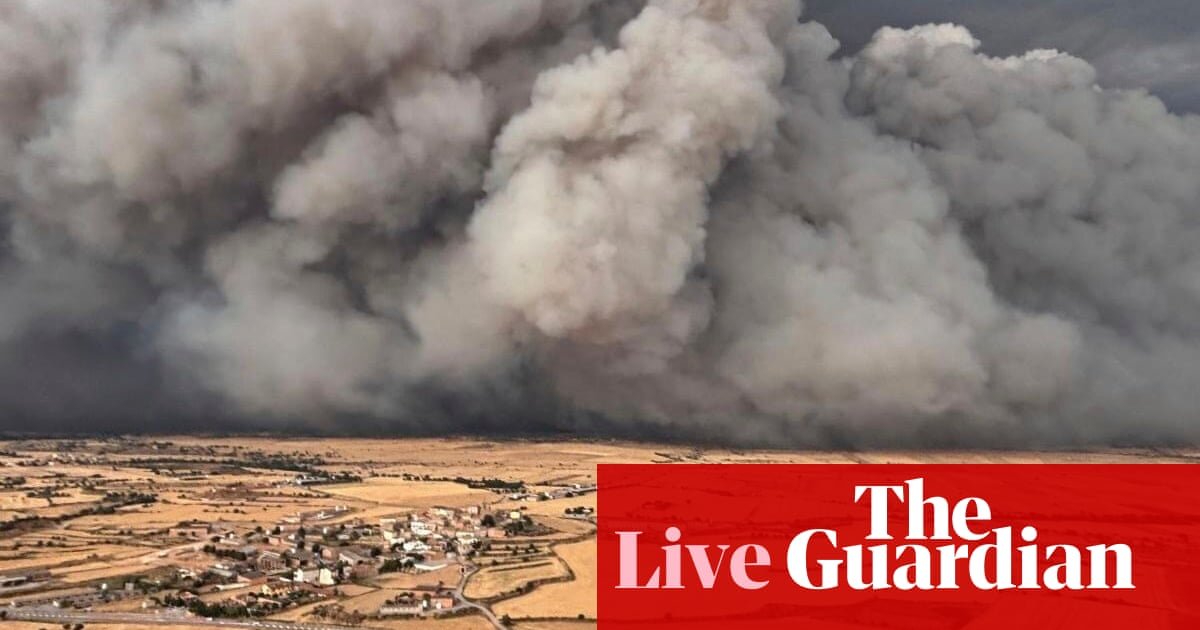
Police investigating two deaths in Catalan wildfire
Sam Jones
Officers from Catalonia’s regional police force, the Mossos d’Esquadra, are investigating the deaths of the two men whose bodies were found on Tuesday by firefighters tackling the blaze near the town of Coscó in Lleida province.

According to the Catalan interior minister, Núria Parlon, the two victims were farm workers who had been trapped by the flames as they tried to reach their vehicles.
In a statement, the regional fire department said the wildfire had shown “extremely violent and erratic behaviour due to the influence of the nearby storms”, adding that the arrival of rain had helped bring the blaze under control.
“Like yesterday, today is going to be complicated with regard to the risk of forest fires,” the service said on Wednesday morning. “The arrival of the storms that have been forecast for this afternoon could make extinguishing the fires more complicated. Take extreme care and call [the emergency services] if you see a column of smoke or fire.”
The regional president, Salvador Illa, has echoed the warning, telling people that such fires can spread far more quickly than you might think.
“These fires aren’t like the ones we used to have,” he said on Wednesday.
“When you find out how they evolve, you get goosebumps. There are really dangerous fires.
People see them in the distance and say, ‘I’ve got time’. No, you don’t. You’ve got no time at all because fire moves very quickly.”
Key events
Lorenzo Tondo
A 70-year-old lorry driver has been found dead inside his vehicle in northern Italy, in what may be the country’s first fatality linked to the ongoing heatwave.
The man was discovered shortly after 6.30am on Wednesday, parked at a motorway rest area between Sirmione and Peschiera del Garda, in the province of Brescia. Emergency services arrived at the scene, including fire crews, medical responders and officers from the Padova Sud motorway police unit, but were unable to revive him.
Initial reports suggest the man died of a sudden illness, and while the exact cause has yet to be confirmed, doctors believe the extreme heat may have been a contributing factor.
Leaders should remind the public why ambitious targets matter – The Guardian’s view
The Guardian’s view
At times like now, with dangerously high temperatures in several European countries, the urgent need for adaptation to an increasingly unstable climate is clearer than ever.
Could the current dangerous heat help to refocus minds? Portugal and Spain both recorded new records at the weekend, with temperatures over 46C. This week, scientists at a conference in Exeter are gathering to discuss climate tipping points. Generally this term refers to the passing of dangerous limits – such as melted ice sheets – after which catastrophe becomes much harder to prevent. But Prof Timothy Lenton points out that it can also be used positively. Two examples are the accelerating uptake of solar power and electric vehicles.
As well as supporting people to cope with the heat, and promoting adaptations of various kinds (for example, in building and urban design), European leaders should use current conditions to remind the public how much is at stake, and reinforce the importance of ambitious, achievable targets.
Climate despair is deadly, but the anxiety produced by recognition of the risks can be harnessed to positive effect. As well as a problem to be dealt with, the heatwave could be viewed as a teachable moment – when the public becomes more receptive to the pressing case for change.
Heatwave in France sparks political row over air-conditioning

Angelique Chrisafis
in Paris
Over in France, the heatwave has sparked a political row over air-conditioning.
As most of France sweltered in the heat, the far-right leader, Marine Le Pen seized a canvassing opportunity ahead of the 2027 presidential election, announcing she would put in place a “grand plan for air conditioning” for the nation if she won power.
In parliament, Le Pen, an MP for the Pas-de-Calais in northern France, said “air conditioning saves lives”. She said there was a problem in France if public services “are unable to function because of a lack of air-conditioning, unlike dozens of countries across the world.”
Eric Ciotti, a Le Pen ally, put down a bill in parliament this week calling for “obligatory air conditioning” for key public spaces.
France has a comparatively low number of public spaces and private homes with air-conditioning, compared to neighbouring countries such as Italy. In 2020, 25% of French homes had air-conditioning, compared to 14% in 2016, according to the national environment agency, Ademe. More homes in the south of France have air-conditioning with comparatively few in the Paris area or the east of France.
The government attacked the far-right as ignorant and “incompetent” for suggesting air-conditioning was a solution to the climate crisis. The environment minister, Agnès Pannier-Runacher, said air-conditioned spaces in care homes for elderly people had been obligatory in France for 20 years. She said that, although vulnerable people should be protected from the heat, air conditioning “must not be installed everywhere” because it generated a rise in temperatures outside and was “the wrong answer”.
The Green leader, Marine Tondelier, attacked Le Pen for an environmental policy limited to “buying air-conditioning units”. Tondelier said there had to be progress made on green spaces in cities and proper insulation of buildings.
Police investigating two deaths in Catalan wildfire
Sam Jones
Officers from Catalonia’s regional police force, the Mossos d’Esquadra, are investigating the deaths of the two men whose bodies were found on Tuesday by firefighters tackling the blaze near the town of Coscó in Lleida province.
According to the Catalan interior minister, Núria Parlon, the two victims were farm workers who had been trapped by the flames as they tried to reach their vehicles.
In a statement, the regional fire department said the wildfire had shown “extremely violent and erratic behaviour due to the influence of the nearby storms”, adding that the arrival of rain had helped bring the blaze under control.
“Like yesterday, today is going to be complicated with regard to the risk of forest fires,” the service said on Wednesday morning. “The arrival of the storms that have been forecast for this afternoon could make extinguishing the fires more complicated. Take extreme care and call [the emergency services] if you see a column of smoke or fire.”
The regional president, Salvador Illa, has echoed the warning, telling people that such fires can spread far more quickly than you might think.
“These fires aren’t like the ones we used to have,” he said on Wednesday.
“When you find out how they evolve, you get goosebumps. There are really dangerous fires.
People see them in the distance and say, ‘I’ve got time’. No, you don’t. You’ve got no time at all because fire moves very quickly.”

Jakub Krupa
Let’s go back to Sam Jones in Madrid for the latest on the Catalan wildfire deaths (11:41).
EU trade chief goes to Washington for tariff talks with US
In other high stake talks, EU trade chief Maroš Šefčovič will be in Washington today in another attempt to strike a tariff deal with the US before the 9 July deadline next week.
Our Brussels correspondent Jennifer Rankin takes a look at the EU’s longest-serving commissioner, who has built up a reputation as a reliable and trustworthy fixer.
Separately, the Guardian’s Lisa O’Carroll reported that EU member states have been advised there could be four options emanating from this week crunch talks between Šefčovič and US trade representative Jamieson Greer over tariffs.
One option is no deal but another more likely scenario of the three remaining is a deal in which both signs are aligned “in broad brush strokes” but centre, like the UK’s deal, on a limited number of sectors such as cars and steel.
This would leave the threat of future tariffs on other sectors open, risking new crises emerging without warning during the remainder of the Trump term.
A third option is a delay, extending talks beyond 9 July. This carries the risk of Donald Trump’s threatened 50% unilateral tariffs being imposed on all imports from the EU from 10 July.
And a fourth option is an “imbalanced deal”, the type that would favour the US, something Emmanuel Macron last week said he would not accept.
Details of the negotiations were not shared in the 45 minute briefing given by Ursula von der Leyen’s head of cabinet Bjoern Siebart and Sabine Weyand, director general of the trade commission, best known in the UK as Michel Barnier’s right hand woman during Brexit negotiations.
EU ambassadors gave also been warned that the 10% blanket tariff may remain but that if they cannot secure a reduction then they will try and extract duty free exemptions in some sectors.
A delegation headed by trade adviser Thomas Baert flew to Washington on Monday for technical talks with Šefčovič joining them tomorrow for talks with trade representative Jamieson Greer.
He is likely to return to brief member states on Thursday with a possible further of ambassadors meeting on Friday ahead of next week’s deadline.
Macron speaks with Putin on Ukraine, Middle East in first direct call in over two years
In other news, French president Emmanuel Macron spoke by telephone with Russian president Vladimir Putin last night in their first direct conversation in more than two years, French media reported.
AFP said Macron urged Putin to accept a ceasefire in Ukraine, but Russia’s leader hit back by blaming the West for the conflict.
The Élysée Palace said in its readout that Macron “emphasised France’s unwavering support for Ukraine’s sovereignty and territorial integrity” and “called for the establishment, as soon as possible, of a ceasefire and the launch of negotiations between Ukraine and Russia for a solid and lasting settlement of the conflict.”
A Kremlin statement reported by AFP said Putin reminded Macron that “the Ukrainian conflict is a direct consequence of the policy of western states”.
The two leaders also spoke about Iran to “coordinate their efforts” agreeing to “speak soon in order to follow up together on this issue,” the agency reported.
On Wednesday, the Kremlin claimed the call was organised after a request by Macron, and praised the talks as “very substantive,” lasting over two hours.
Élysée said the Ukrainian president Volodymyr Zelenskyy was told about the call in advance.
A German government spokesperson later confirmed they had also been told about the conversation, while adding that German chancellor Friedrich Merz had no plans to hold a similar phone call with Putin.
The call was welcomed by the Hungarian prime minister Viktor Orbán, who repeatedly criticised the EU’s policy on Russia and called for more engagement with Moscow.
On his social media, he said:
Finally!!! There is no solution to the Russia-Ukraine war on the battlefield. The key is negotiation. We need diplomats, not generals!
The call took place just hours before the US said it was halting some shipments of weapons to Ukraine amid concerns that its own stockpiles have declined too much, officials said Tuesday, a setback for the country as it tries to fend off escalating attacks from Russia.
Germany could break all-time record temperature as heatwave hits

Deborah Cole
in Berlin
Temperatures are expected to surge close to the 40-degree Celsius mark across much of Germany on Wednesday, and could break the all-time record for Germany of 41.2 degrees, set in July 2019.
Drought-like conditions led more than 40 districts to restrict water use, including for farmers and gardeners, in addition to dozens of municipalities calling on citizens to conserve water.
In Brandenburg state surrounding Berlin, two forest fires broke out on Tuesday, with high temperatures and munitions in the soil complicating the work of firefighters, who by the evening had the situation under control.
The Bild tabloid splashed “Baking oven Germany” and interviewed people working outside in the stifling heat.
“The feedings in the enclosures alone leave us in the blazing sun for two hours,” said Julian Heck, tending to the sea lions at Cologne zoo with his colleague Andreas Hölscher.
The animals themselves were faring better, Hölscher said. “They like to lie in the sun in the morning. Afterwards they can cool off in the cold fountain water.”
Nurse Babette Jacobus at a hospital in Berlin’s Marzahn district said she wore a cooling vest similar to a jersey, held under a faucet and then wrung out, to cope with her strenuous tasks of moving patients in and out of bed. “You quickly start sweating – especially in this heat. The vest is lightweight and comfortable but doesn’t get you wet.”
The hospital itself introduced climate coping measures four years ago including greening the facade, covering the windows externally with foil and hanging cooling curtains in patients’ rooms.
Municipal authorities across the country were scrambling to help the most vulnerable, racing to set up “cool-down rooms” for the public and hotlines for the elderly and ill.
The association of cities and towns has called for another five billion euros annually from states and the federal government to cope with the impact of ever-more-frequent heatwaves.
European Commission proposes 2040 climate target with ‘flexibilities’ for industries
The European Union has just unveiled its plan to reduce the EU’s net greenhouse gas emissions by 90% by 2024, when compared with 1990 levels.
You can follow the European Commission’s press conference announcing the details of the plan here.
The commission said the target “will give certainty to investors, innovation, strengthen industrial leadership of our businesses, and increase Europe’s energy security.”
“Defining the 2040 climate target now will enable the EU to put in place the necessary policies and investments to ensure that the transition to climate neutrality goes hand in hand with a strong and stable economy, competitive industry and future-proof jobs in Europe,” it argued.
But in a hope to soften the blow for some of Europe’s key domestic industries, the plan includes “greater flexibilities across sectors to help achieve targets in a cost-effective and socially fair way,” it said.
Despite some backlash against green policies, the EU insisted that its latest Eurobarometer polling, published last week, showed “strong citizens support for EU climate action, providing a solid mandate to stay the course of the EU’s clean transition agenda.”
We will bring you more on this during the day.
Three dead in Spain as extreme temperatures continue
Sam Jones
in Madrid
Two people died in the Catalan province of Lleida on Tuesday after being caught in a wildfire that burned through 6,500 of land in the northeastern Spanish region and led the authorities to order 18,000 people in the area to remain at home.

“Shocked after learning of the death of two people as a result of the fire,” the regional president, Salvador Illa, said in a post on social media.
“My heartfelt condolences to their families. I urge great caution and to follow all the instructions and recommendations of the @emergenciescat services in all affected areas.”
Spain’s prime minister, Pedro Sánchez, also offered his condolences, saying:
“A heartfelt hug to the families of the two people who lost their lives in the extreme fire … My solidarity with all those affected and my appreciation for the emergency services working to extinguish it. In these months of higher risk, let’s please be extra careful.”
Firefighters managed to bring the blaze under control by Wednesday morning.
The two deaths came on the same day that a little boy died, apparently from heatstroke, after being left in a car in the Catalan province of Tarragona.
Eiffel Tower summit remains closed as Paris battles heatwave
In France, the summit of the Eiffel Tower remains closed until Thursday for “everyone’s comfort and safety” as the temperatures in Paris are once again expected to hit mid-30s.
Separately, French media reported there was a 15% increase in emergency services reports in the Île-de-France region yesterday, with more than 900 calls to the heatwave hotline.
More than 300 people were reportedly treated by medics, with two dead, including a 10-year-old girl with underlying health conditions who died visiting the Palace of Versailles with her parents.
Power cuts in parts of Italy as grid faces pressures caused by heatwave, non-stop AC usage
Angela Giuffrida
in Rome
There were power cuts in some areas of Florence, Milan, Rome and Bergamo on Tuesday afternoon as the extreme heatwave continues in Italy.
The black-outs were sparked by the increased pressure on grids because of non-stop AC use as well as the overheating of underground electrical cables.
Traffic lights stopped working, people got stuck in lifts, shops closed early and homes were without power for several hours. The La Rinascente department story in central Florence was evacuated as a precautionary security measure.
French prime minister Bayrou survives eighth no-confidence motion
In other news about people feeling the heat in Paris, French prime minister François Bayrou survived his latest – eighth! – no-confidence motion in parliament last night, after far-right National Rally (RN) lawmakers refrained from backing a measure brought by his opponents on the left, Reuters reported.
Officials from the RN – the single largest party in the National Assembly but short of a majority – said they would not back the no-confidence motion. They prefer to refrain until later in the year, when even more complex talks over passing the 2026 budget threaten to once again topple France’s government.
France records second-hottest June since 1900, minister confirms
France registered its second-warmest June since records began in 1900, the country’s ministry for ecological transition said in comments reported by AFP.
“June 2025 has become the second hottest June since records began in 1900, behind June 2003,” said France’s minister for ecological transition Agnès Pannier-Runacher.
Spain and Portugal also reported the hottest June temperatures in history.
Morning opening: How can we live with that?
Jakub Krupa
As the European heatwave continues and expands east – with Paris, Rome, Berlin, Vienna, Prague and Warsaw all expecting temperatures in the 30s – there are growing debates about how do we adapt to deal with these temperatures.
The World Meteorological Organization, the United Nations’ weather and climate agency, said yesterday that we will have to learn to live with the new normal of extreme heatwaves, which will occur more often and be more intense as the time goes.
And the issue of how do we respond to this increasingly becomes a political issue, too, as parts of the European electorate continue to express their doubts about the cost of climate policies.
EU’s green transition chief Teresa Ribera told my colleague Sam Jones that political cowardice is hindering European efforts to face up to the effects of the climate crisis, even as the continent is pummelled by a record-breaking heatwave.
Ribera said that although the effects of the climate emergency were becoming increasingly obvious, they were still not translating into proper action as some political parties “continue to insist, quite vehemently, that climate change does not exist”, or else say that taking decisions to adapt to environmental realities is too expensive.
You can read the interview here:
I will bring you all the latest updates from across Europe on how the continent is coping with the heat, but also on these debates as the public’s attention turns to another question: how can we live with that?
Italy offers one solution as it introduces limits on outdoor work, but surely that’s not enough and doesn’t address the underlying issues. What else, then?
It’s Wednesday, 2 July 2025, it’s Jakub Krupa here, and this is Europe Live.
Good morning.