

Around 240m years ago, a 12-foot-long reptile called a chirotherium walked along a beach in what was then part of the supercontinent of Pangaea, and what is now the shoreline of Kildonan village, on the rugged, southern coast of the Isle of Arran. Natural dykes of black igneous rock – cooled magma – jut out into the ocean here. The houses on shore are backdropped by grassy cliffs.
We know that this giant proto-crocodile once roamed here because it left behind footprints – which can still be seen today. “This is older than the dinosaurs,” says Malcolm Wilkinson of Arran Geopark, as we crouch down next to the trace fossil. I place my hand in the massive print and attempt to imagine the world millions of years ago, when Scotland sat just north of the equator and the climate was tropical.
After they were made, Malcolm says, these footprints were covered in layers of silt, deposited by water or wind, which protected them from erosion and created a natural mould. Over the next few million years, layers of sediment gathered and compacted on top, cementing the grains and turning the soft mud around the footprint into solid red sandstone. The footprints turned into fossils, and were thrust back to the surface when the Atlantic opened about 60m years ago, tearing Europe and North America apart.
As the younger rocks slowly eroded the trackway became visible. Similar prints were first discovered in the Victorian era, and the creature was named chirotherium – “hand-beast” – because the fossils look like giant, human handprints.
Just off the west coast of Scotland and reachable in a little over two hours from Glasgow, Arran has long been known for its rocks, regularly welcoming groups of hard hat-clad students on field trips. In April, it became Scotland’s newest Unesco Global Geopark (there are two others, in Shetland and the North West Highlands), in recognition of the world-class geology here, which records tectonic plate collisions and shifting continents.
To walk around Arran is to walk through 600m years of Earth’s history, and my plan is to hike the 65-mile Arran Coastal Way, which circumnavigates the island, over six days. Thankfully for laymen like myself, the history is spelled out through informative Geopark signage along the way.
As the ferry approaches Brodick, the serrated silhouette of the northern mountains comes into focus, the sandstone castle nestled in the greenery below and the mysterious lump of the “Holy Isle” drawing the eye south. The island is divided by the Highland Boundary Fault, a geological line where tectonic plates once collided, separating Scotland’s rolling lowlands from the mountainous highlands.
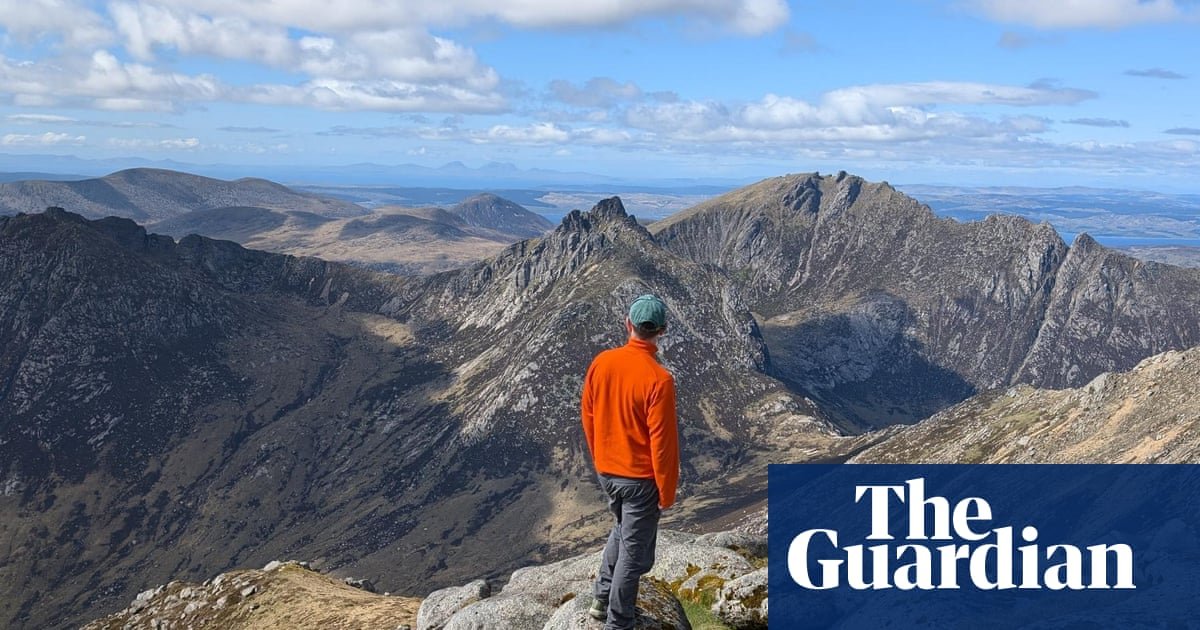
On day one of the Coastal Way I head up Goat Fell, Arran’s highest peak (874 meters), and witness this: the granite mountains of the north have jagged ridgelines and tower over deep glens, sculpted by glaciation, while to the south the scenery is soft and green.
That evening I stay at the Corrie Hotel and follow a Geopark leaflet to the spot where a sand dune was struck by lightning 270m years ago, locking it in time a stone’s throw from the centre of the village. Staring at this “fossilised fulgurite” and imagining that desert lightning bolt is like staring into a different universe.
Along the coast is another trackway, in a remote spot where Arran’s only coal seam was exposed to the surface. This one was left by a six-foot millipede that lived 300m years ago, and would be easily missed without the small, oak Geopark signpost. A pod of dolphins swims by as I reach it, stealing the scene, jumping joyfully just offshore.
Four miles north sits the most famous geological site on Arran – Hutton’s Unconformity. James Hutton, the father of modern geology, visited the island in 1787. At Newton Point, a rocky outcrop in the north of Arran, he observed rock contact between gently sloping sandstone and older, steeply dipping schists. This led Hutton to reason that if natural processes had occurred in the past at the same rate observable in his day, this formation, and so the Earth, must be millions and not thousands of years old – as was widely believed by scholars at the time.
Happily, a holidaying geologist is on hand to explain this to me, though he is, by his own admission, “more excited about the bloody otter” he’d just spotted.
I eat fish and chips at the community-owned Lochranza Country Inn and collapse into Lochranza Youth Hostel. A simple (but private) bunk bed provides all the comfort I need. The next day I walk a mighty 19 miles along the boulder-filled coastline and quiet roads around the west of Arran, camping near King’s Cave, where iron age crosses are carved into the stone, and watch gannets dive bomb into the sea as the sun sets over the Kintyre Peninsula.
Occasionally, I abandon the geological hunt altogether; stopping to watch otters fishing, indulging in a whisky and chocolate tasting at the newly opened Lagg Distillery, or relaxing at The Lagg Inn, whose leafy beer garden is tucked away next to a river.
As my walk happens to coincide with perhaps the sunniest week in Arran since Scotland sat at the equator, it isn’t hard to convince Malcolm to meet me down at Kildonan shore. “This really is a world-class geological site,” he tells me, pointing to the shoreline. While we wait for the tide to reveal our “pre-dinosaur” footprint, Malcolm explains the science of the nearby dyke swarms – the black “walls” jutting into the sea. “They’re magma which was forced up vertically through cracks in the Earth, and have since eroded away,” he says. “This is a record of a time Europe and North America were pulled apart; and the Atlantic was born.”
Seals lounge around on these globally significant rocks, digesting their breakfast in the sun. “The special thing about Arran is that it has rock types from basically every geological period of the last half billion years,” Malcolm says. “We’ve got the main part of the history of the Earth here – and it’s so accessible.”
Off shore sits the microgranite mound of Ailsa Craig, home to an enormous colony of gannets, and Pladda, an island with a scenic lighthouse, sitting on what was once molten magma.
That evening, via the plummeting waterfalls of Glenashdale, I reach Whiting Bay, and watch an otter scurrying in the sunset before setting up camp. With careful consideration for tide times, my final day skirts along boardwalks and seabed to Lamlash, Arran’s most populous village.
I stop for a swim at a secluded bay and oystercatchers (my constant companions on the walk) squeak their farewells. Brodick soon welcomes me back with its sublime mountain vistas. As my ferry sails back to the mainland I gaze back at Goat Fell, and the words of the writer Nan Shepherd come to mind: “the shortsighted cannot love mountains as the longsighted do”.
The Corrie Hotel has doubles from £115 B&B, Lochranza Youth Hostel has private rooms from £42 or dorm beds from £20, Lagg Inn has doubles from £170. For more information, see Visit Arran