

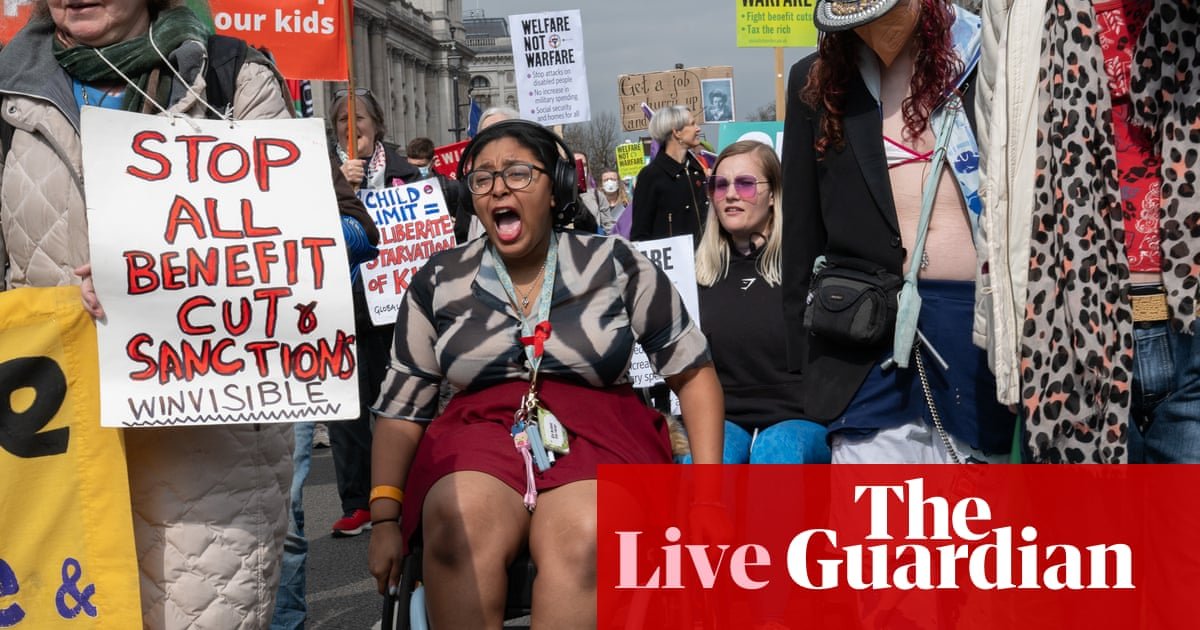
Starmer describes welfare bill concessions as ‘common sense’ – while dodging question about how they will be funded
Keir Starmer has described the compromise welfare bill proposals announced overnight as “common sense” and as striking “the right balance”.
Speaking to reporters on a visit, he said:
It’s very important that we reform the welfare system, because it doesn’t work and it traps people, and therefore we’re going to press ahead with the reforms. And the principles are if you can work, you should work. If you need help getting into work, you should have that help and support. But if you can’t work or there’s no prospect of work, then you must be protected.
We need to get it right. That’s why we’ve been talking to colleagues and having a constructive discussion. We’ve now arrived at a package that delivers on the principles with some adjustments, and that’s the right reform, and I’m really pleased now that we’re able to take this forward …
For me, getting that package adjusted in that way is the right thing to do. It makes the right balance. It’s common sense and we can now get on with it.
The claim that the current system “traps people” on benefits infuriates some campaigners because Pip (the personal independence payment) is paid to people who have extra costs because they have to cope with a disability and it does not just go to people out of work. Some Pip claimants are working. Starmer, though, believes Pip incentivises people not to find work.
Asked how the government would pay for the concessions, which will cost about £3bn a year, Starmer replied:
The funding will be set out in the budget in the usual way, as you’d expect later in the year.
Key events
-
Afternoon summary
-
Starmer defends treating Reform UK, not Tories, as main opponents, saying battle with populism must be fought now
-
Starmer describes welfare bill concessions as ‘common sense’ – while dodging question about how they will be funded
-
International development committee says supplying F-35 components for Israel may contravene international law
-
Badenoch says welfare U-turn shows Labour ‘no longer in control’, and bill now ‘worst of all worlds’
-
No 10 should not assume Labour revolt over welfare bill is over, Diane Abbott says
-
At least 50 Labour MPs still opposed to welfare bill, Starmer warned, amid claims Tuesday’s vote could be very tight
-
UK and France expected to announce one-in, one-out returns agreement for small boat migrants, reports say
-
Disability rights campaigners urge Labour MPs to keep fighting ‘impending disaster’ welfare bill
-
Starmer says he ‘deeply regrets’ using ‘island of strangers’ line in immigration speech, but arson attack had distracted him
-
No 10 rejects claim welfare U-turn shows PM caves under pressure, saying it shows this is ‘government that listens’
-
No 10 does not rule out tax rises, but says there will be no ‘permanent increase in borrowing’ to fund welfare U-turn
-
IFS says new Pip policy will create ‘big differences’ in what’s paid to people with similar conditions before and after cut-off
-
What thinktanks say about what welfare bill U-turn will cost
-
Disability rights campaigners say they remain opposed to welfare bill, claiming U-turn creates ‘two-tier system’
-
Lib Dems say they will continue to oppose welfare bill, despite U-turn, because it mean ‘some of most vulnerable’ losing help
-
Jeremy Corbyn joins Tories in saying welfare bill U-turn creates ‘two-tier benefits system’
-
Green party urges Labour MPs to keep fighting welfare bill, saying even with U-turn it’s still not ‘humane’
-
Minister dismisses claim welfare U-turn sign of weakness, saying voters ‘respond very positively to politicians listening’
-
Many Labour MPs will still vote against welfare bill despite U-turn, leftwinger Nadia Whittome claims
-
Curtice says Treasury needs £4bn to fund welfare bill and WFP U-turns, and taxes likely to go up
-
Welfare bill U-turn could cost Treasury around £3bn a year, Resolution Foundation head Ruth Curtice says
-
‘Good and workable compromise’ – lead Labour rebel Meg Hillier’s statement on why she’s accepting U-turn
-
No 10 defends U-turn, saying ‘we have listened to MPs worried about pace of change’
-
Full text of Liz Kendall’s letter to Labour MPs confirming welfare bill U-turn
-
Starmer’s ‘humiliating U-turn’ will create ‘two-tier benefits system’, Tories say
Afternoon summary
-
Keir Starmer still faces a four-day battle to persuade Labour MPs to back his UC and Pip bill after the £3bn-a-year concessions announced overnight failed to fully quell the backbencher rebellion over the issue. Although Meg Hillier, who tabled the reasoned amendment that would kill the bill, has welcomed the U-turn, many MPs remain unconvinced. At least 50 MPs are still determined to oppose the bill, the Labour MP Cat Eccles told the World at One. (See 2pm.) Disability rights campaigners have also urged MPs to continue opposing the bill. (See 1.03pm.)
Here are comments from two more Labour MPs who say they remain opposed to the welfare bill, despite the concessions announced by Keir Starmer.
These are from Bell Ribeiro-Addy.
These proposed concessions to the Welfare Bill don’t go far enough.
No consultation with disabled people
No government impact assessment
No OBR analysis
No publication of PIP or Mayfield Review
The Reasoned Amendment was clear. Disabled people are being ignored.
A two-tier welfare system is not a concession, it’s discrimination.
Even with new proposals, this £3bn cut will deepen poverty and hardship for disabled people.
No tweaks can justify this assault on welfare.
MPs are being asked to vote on billions in cuts, based on a last-minute new draft or verbal promises.
The Govt plans to cram the rest of the Bill into 1 day.
No real scrutiny or consultation.
The debate around this Bill has become too toxic. It should simply be scrapped.
And this is from Simon Opher.
The government has shifted their position on the welfare reform bill, which is welcome. I’m glad they are listening. It could go some way to help disabled people stay in the jobs they have, and helps take the pressure of those who were most anxious about the potential impact of the reforms on their lives.
However, legislating inequality into our benefits system is not the way to solve this. It will condemn younger disabled people, and those yet to become disabled, to lives of worsening health and needless hardship. The support that disabled people receive is, at best, limited. The ‘concessions’ look more like an attempt to sort a political problem, rather than a serious review of how best to support disabled people and those with long term health issues in their lives and at work. The support you get should depend on need, not when you applied for it.
The changes do not tackle the eligibility issues that are at the heart of many of the problems with PIP.
The bill should be scrapped and we should start again and put the needs of disabled people at the centre of the process.
Amanda Akass from Sky News says Labour MPs planning to rebel on the welfare bill next week have set up their own WhatsApp group. She said it already has 50 members.
One rebel tells me a 50 strong Whatsapp group has already been created for Labour MPs who are still planning to vote against the welfare bill – “so it’s perfectly plausible we’ll get back to bill killing numbers over the weekend” @SkyNews
In January there was a controversy when a government minister seemed to rule out the UK joining the Pan-Euro-Mediterranean Convention (PEM), a Europe-wide customs arrangement. The minister may have been influenced by reporting that described the little-known arrangement as a customs union, when it’s not. (Its actually a deal relating to how cumulation is enforced when rules of origin regulations apply to imports.) Pro-Europeans found it depressing that the government seemed petrified of something technical and benign just because it might alarm the Brexiters. Eventually No 10 said the idea was not being ruled out.
Now, as Politico reports, the government has said it is going to actively consider joining.
Starmer defends treating Reform UK, not Tories, as main opponents, saying battle with populism must be fought now
Tom Baldwin, Ed Miliband’s communications chief when Miliband was Labour leader, has a good claim to be the writer who best “gets” Keir Starmer. He got good access to the PM for the biography he published last year and his new interview for the Observer is definitely worth a read.
The main news line is probably what Starmer said about his “island of strangers” comment in an immigration speech earlier this year being a mistake. (See 12.40pm.) Starmer hinted at this in an interview with the New Statesman’s Tom McTague recently, but Baldwin got him to admit that it was a big error. Starmer said he was distracted by the arson attack on his home that had just happened, and that as a result he should have “held [the speech] up to the light a bit more” before he delivered it.
Starmer also told Baldwin that there were “problems with the language” in his foreword to the immigration white paper published the same day. In the document Starmer said the damage done to the UK by net migration soaring under the Tories had been “incalculable”. (The document reads as if what he was trying to say was that it was just the damage done to political trust by high migration that was incalculable, but that is not what he said; in the Observer, Starmer does not elaborate on what exactly the “problems” were.)
When Sky’s Beth Rigby asked Starmer recently what his biggest mistake was in his first year in office, all she got was the admission that he should have communicated what he was doing better. Speaking to Baldwin, Starmer was forthcoming about other errors too.
-
Starmer said that what became known as his “things can only get worse” speech in Downing Street last summer was a mistake. It “squeezed the hope out”, Starmer said. “We were so determined to show how bad it was that we forgot people wanted something to look forward to as well.”
Not everyone thought it was a good idea when I appointed her. It was my call, my judgment, my decision, and I got that wrong. Sue wasn’t the right person for this job.
-
He said his response to the controversy about accepting clothes donations was not as good as it might have been because his wife was implicated, and he was angry about how she was being attacked. This clouded his judgment, he suggested.
Part of the problem is that I got emotionally involved. One thing I’m reasonably good at usually is staying calm. But when they dragged Vic into it through no fault of her own, that made me angry.
There was another interesting line about Reform UK.
-
Starmer defended treating Reform UK, not the Tories, as the main opposition, saying Labour needed to start fighting Nigel Farage’s party now. He said:
If we’re going to have a battle with Reform – a battle for the heart and soul of the country – we’re better off having it now. If we’re to win that battle, we have to be the progressives fighting against the populists of Reform – yes, Labour has to be a progressive political party.
For many people, though, the most memorable passage may be where Baldwin describes Starmer going to Leeds after his brother died on Boxing Day last year to clear out his house. Starmer had always been protective of his brother, who had learning difficulties, and this was a job he did not want to delegate to anyone else. Baldwin writes:
Starmer asked his armed police bodyguards to wait behind and opened the glass-fronted door. Once inside, he filled black bin liners with rotten food from the fridge and dirty clothes from the floor. Then the prime minister got to work cleaning the bathroom and toilet …
Couldn’t he just have got cleaners to sort the house out?
“No,” he says, “I didn’t want anyone else there. He was my brother – I didn’t want to let him down.”
Nick “hadn’t kept the place very clean”, explains Starmer, suddenly gulping for words before describing how “I was putting what he’d left of his life in a bag”. The prime minister forces himself back into his more familiar and less expressive form before continuing. “But – but – there you go, I suppose.”
Starmer describes welfare bill concessions as ‘common sense’ – while dodging question about how they will be funded
Keir Starmer has described the compromise welfare bill proposals announced overnight as “common sense” and as striking “the right balance”.
Speaking to reporters on a visit, he said:
It’s very important that we reform the welfare system, because it doesn’t work and it traps people, and therefore we’re going to press ahead with the reforms. And the principles are if you can work, you should work. If you need help getting into work, you should have that help and support. But if you can’t work or there’s no prospect of work, then you must be protected.
We need to get it right. That’s why we’ve been talking to colleagues and having a constructive discussion. We’ve now arrived at a package that delivers on the principles with some adjustments, and that’s the right reform, and I’m really pleased now that we’re able to take this forward …
For me, getting that package adjusted in that way is the right thing to do. It makes the right balance. It’s common sense and we can now get on with it.
The claim that the current system “traps people” on benefits infuriates some campaigners because Pip (the personal independence payment) is paid to people who have extra costs because they have to cope with a disability and it does not just go to people out of work. Some Pip claimants are working. Starmer, though, believes Pip incentivises people not to find work.
Asked how the government would pay for the concessions, which will cost about £3bn a year, Starmer replied:
The funding will be set out in the budget in the usual way, as you’d expect later in the year.
International development committee says supplying F-35 components for Israel may contravene international law

Geneva Abdul
Geneva Abdul is a Guardian reporter.
The UK’s exemption of F-35 components from suspended arms exports to Israel may be incompatible with international law, the chair of the international development committee has warned.
In a letter to business secretary, Jonathan Reynolds, committee chair Sarah Champion raised questions over the government’s contentious decision to exempt parts for F-35 jets to Israel, and whether the carve out decided in September 2024 is compatible with the Arms Trade Treaty, the Genocide Convention and the Geneva Conventions.
The letter comes after MPs, lawyers and human rights organisations have for months argued against the continued exports which they describe as a serious violation of humanitarian law. In September, the government suspended 30 arms export licenses, but carved out the supply of components for F-35 jets, warning an embargo could disrupt the global programme and Nato’s peace and security.
The UK government, which faces court action over the decision, has justified the continued export of components on reasons of international peace and security. The government has also acknowledged, in court documents, that the supply of F-35 components for potential use in Israel is in breach of its own arms export control laws. Britain supplies 15% of the value of the F-35 jet, mainly through BAE systems.
Champion said in her letter:
If there is the ‘potential’ for an ‘overriding’ risk of serious violations of IHL/IHRL [international humanitarian law/international human rights law], then the UK must not authorise the export.
In circumstances where there are prolonged blockades of humanitarian aid including food, water and medicine, as well as evidence indicating the mistreatment of detainees by Israel, there are clearly risks of serious violations of the right to life, health, food security, and the prohibitions on cruel, inhuman and degrading treatment and torture. The clear risks of serious IHL and IHRL violations are undisputable.
Concerns from the international development committee come days after the UK announced the expansion of its nuclear deterrent by buying 12 F-35A jets, which are capable of carrying conventional munitions and also the US B61-12 gravity bomb.
The letter also asks the government several questions including whether the government accepts it has knowledge that Israel is committing internationally wrongful acts and that the export of F-35 components is aiding or assisting these wrongful acts.
The government was asked to respond by 11 July.
Here are some pictures from Kemi Badenoch’s visit to Carver Barracks in Essex today.
Badenoch says welfare U-turn shows Labour ‘no longer in control’, and bill now ‘worst of all worlds’
Kemi Badenoch has described the welfare bill as “the worst of all worlds” in the light of the concessions announced overnight.
Speaking to reporters on a visit to Carver Barracks in Essex, she said:
I think we’re seeing a government that is floundering, a government that is no longer in control despite having a huge majority.
I don’t see how they’re going to be able to deliver any of the things they promised if they can’t do something as basic as reducing an increase in spending.”
It’s a real shame because what they’re doing now with this U-turn is creating a two-tier system … this is the worst of all worlds.
No 10 should not assume Labour revolt over welfare bill is over, Diane Abbott says
Diane Abbott, the veteran Labour leftwinger and longest-serving female MP (“mother of the House), has said that No 10 would be wrong to assume the rebellion against the welfare bill is over. She posted this on social media this morning.
On the rebellion over welfare, reports of its death are greatly exaggerated. Postponing cuts is not enough. Many MPs believe the cuts are wrong in principle, hurting the people we are supposed to protect. Others know how unpopular the policy will remain.
The Cat Eccles interview on the World at One implies she’s right. (See 2pm.)
Here are some more social media posts from Labour MPs who says they remain opposed to the bill, despite the big concessions announced overnight.
From Andy McDonald
The govts proposed climbdown for current recipients of PIP and UC health is welcome. But it’s just poverty, delayed – poverty postponed – for millions of people in the future. So, for those reasons, I’ll be voting against.
From Neil Duncan-Jordan
These proposals will still force disabled people into poverty.
I oppose a two-tier approach where the support you get depends on when you applied – not on need.
There’s a fairer, more Labour way.
Let’s ask wealthy corporations and individuals to pay – not the disabled.
From Richard Burgon
Even with the changes, the Disability Cuts Bill will see nearly half a million disabled people denied PIP over the next 4 years.
MPs shouldn’t vote to cut support for disabled people who’ll need help cutting up food, washing or going to the toilet.
I’m voting against the Bill.
From Imran Hussain
The Government’s reformed welfare bill doesn’t go far enough.
It imposes £3bn in cuts and creates a 2-tier system. I’ll be voting against it.
Read my piece in the Mirror on why I oppose the principles of this Bill.
From Peter Lamb
Have now heard what the new PIP deal is.
It’s for others to disclose and every MP must make up their own mind, but to me it’s insufficient when better options have repeatedly been put forward and ignored.
I will be voting for the amendment/against the bill, alone if necessary.
At least 50 Labour MPs still opposed to welfare bill, Starmer warned, amid claims Tuesday’s vote could be very tight
Ministers should not be confident that they will pass the welfare bill on Tuesday, despite the huge concessions welcomed by the MP who tabled the reasoned amendment to kill the bill, a backbencher told the World at One
Cat Eccles, who was elected MP for Stourbridge last year, said that she was aware of around 50 to 60 Labour rebels who were still oppposed to the bill. But she said she could be more.
Eccles is one of more than 120 Labour MPs who signed the reasoned amendment that would have blocked the bill at second reading. The government currently has a working majority of 165, which means that if 83 Labour MPs were to vote with all the opposition parties on a measure, the government would lose.
Asked for her response to the U-turn, Eccles said:
I’m glad that the government is finally listening, but it’s really disappointing that it is at the 11th hour. I and others have been raising our concerns since Liz Kendall first stood at the dispatch box to announce these policies back in March, so they’ve had three months to listen.
So to say this week that they’re surprised that we’ve got these concerns is really disingenuous … I think they do need to start really being a bit more collaborative with their back benches, because we do have experience amongst us, we do have a lot of knowledge, and some of us really do know what we’re talking about, especially when it comes to the system.
Asked if the changes were enough too get her to back the bill, Eccles replied:
For me? No, it’s too little too late.
We’re not going to be able to see the detail in advance … It’s not good enough for me.
Asked if other Labour MPs felt the same way, Eccles replied:
It’s quite mixed. Some people are feeling quite reassured by what’s been coming out since last night …
But many of us still feel that it’s not OK – particularly around the Pip four points scoring criteria, saying that existing claimants will still get it, but new ones may not.
There’s a worry there that we’ll create a two-tier system.
And it’s looking like they’ll still be billions of pounds of brutal cuts.
So it’s just too quick for MPs to be able to understand how these concessions will really work. And I think we should still be pressing pause and looking at this again.
Eccles did not offer a firm prediction for how many MPs would vote against the bill. Asked how many backbenchers were, like her, still opposed to the bill, she replied:
I know some, 50 or 60 that I’m aware of, but I think there’s a whole bunch of people that we’re not aware of who are feeling uncomfortable. We may not know what they will do until Tuesday evening.
When it was put to her that the vote could be “really very tight indeed”, she replied: “Yes, I think so.”
UK and France expected to announce one-in, one-out returns agreement for small boat migrants, reports say
The UK and France are reportedly expected to announce a one-in, one-out migrant returns deal to crack down on English Channel crossings, PA Media reports. PA says:
Plans for a pilot could be revealed next week, which marks one year since Keir Starmer’s government came to power, or later in the summer, according to the Times.
The deal could see migrants who arrive in the UK by crossing the English Channel in small boats returned to France, while the UK would accept those with legitimate claims to join family already in the country.
It comes as the government has vowed to crack down on people smuggling gangs across the Channel, while crossings are at a record high for this point in the year, totalling 18,518.
Home secretary Yvette Cooper has been leading the talks, the paper added, who is credited with strengthening relationships with French counterparts.
French officials have also agreed to changes that would allow police patrolling the coast to take action in the sea when migrants climb into boats from the water.
Under the new returns deal, a joint processing system between the UK and France would be set up to identify migrants who have a valid claim for family reunification in the UK, the Times reported.
For each person accepted to come to the UK, a migrant would be returned to France and relocated across the country away from its northern coastline where crossings take place.
Downing Street and the Home Office have not confirmed that an agreement will be signed, but have not denied it either.
Responding to these reports, shadow home secretary Chris Philp said:
We pay the French half a billion pounds to wave the boats off from Calais, and in return we get a migrant merry-go-round where the same number still come here.
“The French are failing to stop the boats at sea, failing to return them like the Belgians do, and now instead of demanding real enforcement, Labour are trying a ‘one in, one out’ gimmick.”
The European Stability Initiative, a thinktank, is one of the bodies that has been arguing for a one-in, one-out returns agreement for some time. In a recent article for the Sunday Times defending the plan, John Dalhuisen, a fellow at the thinktank, argued that this plan would solve the small boats crisis. He said:
From an agreed day onwards, the UK would agree with a group of EU countries, ideally including both France and Germany, to swiftly return almost all migrants who arrive irregularly across the Channel. This would reduce crossings to zero within a few weeks. As soon as it became clear that there was no prospect of success, the incentive to undertake a dangerous, costly journey would evaporate. After a few weeks, therefore, the number of transfers back to participating states would also fall to zero …
But what’s in it for a Macron [French president Emmanuel Macron], or a Merz [German chancellor Friedrich Merz]? Ultimately, something similar. Mainstream parties in Europe are leaching support to populists promising much more radical solutions to irregular migration. Right now, they have no policies of their own that credibly offer control. Nor are uglier ones that they are already endorsing (pushbacks at external borders from Greece to Poland, and deals with Tunisia and Libya to intercept boats and take them back before they even get there) working particularly well.
This deal offers the outline of such a policy. Western European countries have every interest in showing their voters that migration can be controlled lawfully and humanely through safe third-country agreements.
Disability rights campaigners urge Labour MPs to keep fighting ‘impending disaster’ welfare bill
Mencap, the learning disability charity, issued a statement overnight welcoming the government’s U-turn on the welfare bill. But it has now issued an expanded statement saying it is still concerned about the legislation.
Jackie O’Sullivan, executive director of strategy and influence at the charity, said:
We are encouraged that campaigners have been heard in their opposition to the planned cuts. But we fear that if, from next year, new claimants for Pip face different rules, there will be a generational divide in the quality of life for people with a learning disability.
Other groups representing the disabled, and their carers, have also restated their opposition to the government’s plans, despite the big concessions announced overnight. I posted some comments from this sector at 11.30am. Here are more organisations speaking out.
The Disability Benefits Consortium, a coalition of more than 100 disability charities, issued a statement saying:
These supposed ‘concessions’ to the cuts bill are just a desperate attempt to rush through a disastrous piece of legislation. By pushing the cuts onto future claimants, the government are betraying the next generation of disabled people. Why should someone who needs support to wash in 2025 be entitled to Pip, but not someone who has the same needs in 2035?
If the bill passes in its revised form, it will still push more people into poverty and worsen people’s health. We urge MPs to use their power to stop this impending disaster. The bill must be stopped in its tracks.
Tim Nicholls, assistant director of policy, research and strategy at the National Autistic Society, said: “
It should not have taken this much pressure to get the government to listen and step back from some of their damaging proposals. Today’s announcement will address some of the fear many autistic people who currently receive Pip felt about losing vital support that makes their daily life more manageable. But autistic people who might need Pip in the future, like autistic children who will become autistic adults, will still be fearful about where they fit in this two-tier system …
The government should do the right thing: hit ‘pause’’ on these changes and let disabled people have a meaningful say on the future of disability benefits. We won’t stop campaigning until the benefits system truly works for autistic people.
And Helen Walker, chief executive at Carers UK, said:
The government has agreed to protect existing claimants on PIP. This will be a huge relief for unpaid carers whose income via carer’s allowance is reliant on the person they care for receiving a relevant disability benefit such as the daily living component of Pip. Many have increased costs and face significant financial challenges because of their caring roles.
It’s important that the government has listened and made changes, but we remain deeply concerned about future carers. Around 12,000 people become an unpaid carer every day in the UK. The bill as it stands will still include the new four-point rule for Pip and doesn’t change the fact that many new claimants will lose out – it still represents a reduction in financial support and a bleak outlook for future carers who won’t be entitled.